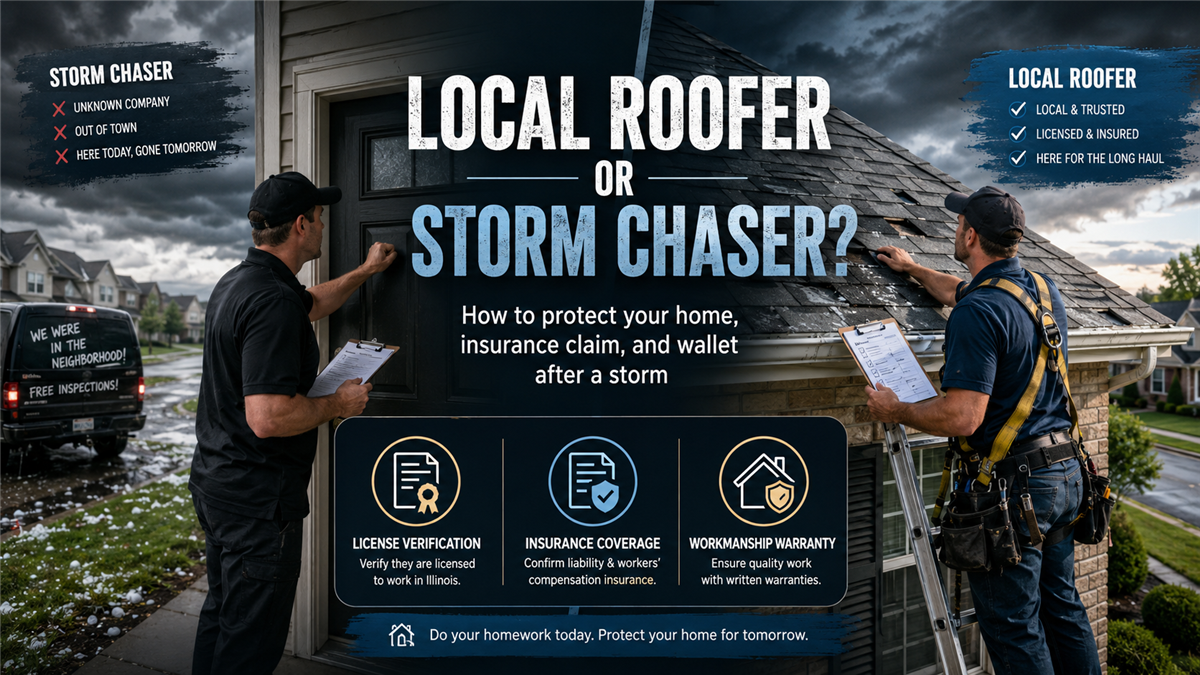
After every major storm that hits the western suburbs, out-of-town contractors descend fast. Here's how to tell the difference — and protect your home, your insurance claim, and your wallet.
If someone has already knocked on your door offering a "free inspection," you're not alone. After any significant hail or wind event across Greater Chicagoland — from Naperville and Aurora to Bolingbrook and Joliet — homeowners report multiple visits per day from roofing companies they've never heard of, many based hundreds of miles away.
This page answers the ten questions we hear most from homeowners evaluating their options after a storm. No sales pitch — just the facts you need to make a smart decision about your roof, your insurance claim, and who you let on your property.
10 questions answered:
- What exactly is a "storm chaser" roofer, and why are they in my neighborhood?
- How do I know if the person at my door is legitimate?
- What's the actual risk of hiring a storm chaser?
- Does Illinois have laws that protect me from storm chaser tactics?
- Should I file an insurance claim, or pay out of pocket?
- What should I look for in a roofer after a major storm?
- I already signed something with a storm chaser. What are my options?
- Local vs. storm chaser — a side-by-side comparison
- Why does TTLC specifically say they're different?
- What's the bottom line?
1. What exactly is a "storm chaser" roofer, and why are they in my neighborhood right now?
A storm chaser is a roofing contractor — or sometimes just a salesperson representing one — who follows severe weather from state to state. When a major hail or wind storm hits a region like Greater Chicagoland, they move in quickly, go door to door, and try to sign up as many homeowners as possible before moving on to the next market.
They're here because Illinois experiences some of the most active storm weather in the Midwest. The National Weather Service regularly confirms significant hail events across DuPage, Will, Kane, and Cook counties. Hail at two inches or above causes widespread roof damage across entire zip codes — which means thousands of potential insurance claims. That's what storm chasers are after.
Not every out-of-area roofer is a scammer. Some are legitimate contractors with real expertise in insurance restoration who travel to help meet demand after major events. Many storm chasers are quite effective at getting claims approved — that part of the process is actually where they shine.
The problem is everything that happens after the paperwork is signed. These companies are optimized for sales volume. They knock doors, document damage, push for fast claim filings, and then — because they're managing dozens of jobs in a short window — they hire whoever they can find to do the actual installation. Those crews may have no ongoing relationship with the company and no accountability for the quality of the work.
The Core Issue
Storm chasers are often very good at getting your insurance claim approved. The real question isn't whether they can sell you a roof — it's what quality of roof you're actually getting, and whether the company will still exist in your area when you need warranty work done two years from now.
2. How do I know if the person at my door is legitimate or not?
Start with three things you can verify in under five minutes:
Check their Illinois roofing license. Every roofing contractor working in Illinois must hold a valid license issued by the Illinois Department of Financial and Professional Regulation (IDFPR). You can look it up at idfpr.illinois.gov. If they can't give you a license number, or if the number doesn't come back valid, stop right there. TTLC's Illinois license number is #104019281 — verifiable directly.
Ask for proof of insurance. A legitimate roofer carries general liability insurance ($1M minimum is standard) and workers' compensation coverage. Ask for a certificate of insurance and verify it's current. If a worker is injured on your roof and the contractor doesn't carry workers' comp, you could be liable as the property owner.
Check their local reviews. Look at Google and the BBB. Are reviews recent, consistent, and from people in your area? A 4.9-star rating from 1,000+ Chicagoland homeowners tells a very different story than a company with 12 reviews from out-of-state addresses.
Beyond those three, pay attention to pressure tactics. If someone tells you that you need to sign today, that the insurance company will only cover the claim if you act now, or that they'll handle everything with your insurer so you don't need to be involved — those are red flags. Illinois law gives you specific protections against these tactics (more on that in Question 4).
3. What's the actual risk of hiring a storm chaser?
The risks are specific and well-documented. Here are the five most common problems homeowners in Greater Chicagoland run into after hiring out-of-town storm chasers:
1
If a storm chaser installs your roof and disappears back to Texas or Florida, your workmanship warranty is essentially worthless. Manufacturer warranties on the shingles may still apply, but the labor warranty — which covers installation errors — is gone the moment that company stops operating in your area.
2
Storm chasers often hire temporary labor to handle volume. These crews may not follow manufacturer installation specs, which can void your shingle warranty from CertainTeed, Owens Corning, or GAF before you even know there's a problem. Improper nailing patterns, missing ice and water shield, and inadequate ventilation are the most common issues.
3
When a storm chaser handles your insurance claim, the relationship effectively becomes between the insurance company and the roofer — not between you and the roofer. The insurance pays out a set amount, and the storm chaser's profit margin comes from whatever they can save on materials. Always inspect the materials delivered to your property and compare them against your written estimate.
4
If your insurance claim doesn't get fully approved, a local roofer will have that conversation with you, explain the gap, and work out a path forward. Storm chasers have been known to go silent when the full claim doesn't go through — if the profit margin disappears, so does the contractor.
5
The National Insurance Crime Bureau (NICB) reports that roofing fraud spikes after every major hail event. Common schemes include inflating damage scope, billing for work not performed, and convincing homeowners to sign an Assignment of Benefits (AOB) that transfers control of the insurance claim to the contractor. This can create complications — including claim denial — that fall on you.
⚠️ Assignment of Benefits Warning
Be very cautious if a contractor asks you to sign an Assignment of Benefits (AOB) or any document that gives them authority over your insurance claim. You have the right to be involved in every step. Contact your insurer directly before signing anything you don't fully understand.
4. Does Illinois have laws that protect homeowners from storm chaser tactics?
Yes. Illinois has some of the strongest consumer protections in the country for exactly this situation.
The Home Repair and Remodeling Act requires contractors to provide a written contract before starting any residential work over $1,000. That contract must include the contractor's name, address, and Illinois roofing license number, along with the total price, a description of the work, and estimated start and completion dates.
The Illinois Consumer Fraud and Deceptive Business Practices Act makes it illegal for a contractor to misrepresent the scope of damage, inflate repair costs, or use high-pressure tactics to get you to sign before you've had time to review your options. The Illinois Attorney General actively investigates complaints related to storm chaser activity after major weather events.
Your right to cancel: Under Illinois law, if a contractor solicits you at your home (door-to-door), you have three business days to cancel the contract without penalty. Any contract signed at your door must include written notice of this right. If it doesn't, the contract may be voidable.
⚠️ Know Your Rights
You are never required to sign anything on the spot. Any contractor who tells you otherwise — that the price goes up tomorrow, that your insurance won't cover it if you wait, or that you must decide now — is using a pressure sales tactic, not stating a fact. Take your time.
5. Should I file an insurance claim, or just pay out of pocket?
This depends on the extent of the damage, your deductible, and your claims history. There's no universal answer, but here's a practical framework:
File a claim if: the damage is widespread (multiple roof slopes affected), hail was 2 inches or larger in your area, and the estimated repair cost significantly exceeds your deductible. For most Greater Chicagoland homeowners after a significant storm, this applies — hail of 2+ inches almost always causes damage that justifies a claim.
Consider paying out of pocket if: the damage is minor and localized, and the repair cost is close to or below your deductible. Filing a claim for a small repair can create a claims record that affects your renewal rates without providing meaningful benefit.
Either way, get an independent inspection first. Don't let the contractor who wants the job be the only person assessing the damage. A reputable local roofer will give you an honest assessment — even if the answer is "you don't need a new roof." That's actually the most reliable sign you've found the right company.
★★★★★"TTLC came out and gave us an honest assessment of our roof after the storm. They told us the damage wasn't as bad as we feared and helped us understand exactly what our insurance would and wouldn't cover. No pressure, just straight answers."
— Google Review, TTLC, Inc. · Naperville, IL
One important note: your insurance company works for you, not for any contractor. Be cautious of any roofer who wants to "handle everything" with your insurance company, or asks you to sign an Assignment of Benefits. You have the right to be present and involved in every step of your own claim.
6. What should I look for in a roofer after a major storm?
After storm season, the right contractor will check five specific boxes:
- An Illinois roofing license you can verify yourself. Non-negotiable. Look it up on the IDFPR website. Don't take their word for it. TTLC's license (#104019281) is public record — check it right now if you like.
- A local address you can drive to. Not a P.O. box or a "regional office" that opened after the storm. A real business address in the Greater Chicagoland area — like TTLC's main office at 23736 W 119th St, Plainfield, IL — where you can show up if something goes wrong.
- Reviews from your neighbors, not from another state. Check Google reviews and look at the names and locations. Are these people from Naperville, Joliet, Aurora, and Bolingbrook? TTLC has 1,033+ Google reviews with a 4.9-star average — from actual Chicagoland homeowners.
- A written estimate before any work starts. Not a verbal ballpark. A line-by-line written estimate that breaks down materials, labor, and scope. This protects you and gives you something to compare against other bids.
- No pressure to sign today. A good roofer gives you time to review, compare, and decide. They won't tell you the price goes up tomorrow or that your insurance won't cover it if you wait. That's a sales tactic, not a fact.
7. I already signed something with a storm chaser. What are my options?
Don't panic — you likely have options depending on where things stand.
If you signed at your home (they came to your door), Illinois law gives you three business days to cancel without penalty under the Illinois Door-to-Door Sales Act. Send your cancellation in writing and keep a copy for your records.
If you signed an Assignment of Benefits (AOB), contact your insurance company immediately and let them know. Your insurer can advise on next steps and may be able to intervene before work begins.
If work hasn't started yet, review the contract for cancellation terms. Even if the formal window has passed, a conversation with the contractor about your concerns is worth having before any materials are ordered or crews are dispatched.
If work has already started or been completed and you're unhappy, document everything with photos. File a complaint with the Illinois Attorney General's Consumer Protection Division, the BBB, and the IDFPR. The Attorney General's office specifically handles roofing contractor complaints and has pursued enforcement action against out-of-state storm chasers operating in Illinois.
Illinois Attorney General Consumer Protection
The Illinois AG's Consumer Protection hotline handles roofing complaints. If a contractor isn't licensed in Illinois, that's a separate violation worth reporting regardless of the contract status.
8. Local vs. storm chaser — a side-by-side comparison
| Factor | Local Roofer (e.g., TTLC) | Storm Chaser |
|---|---|---|
| Physical presence | Permanent local office | Temporary seasonal presence |
| Illinois license | Verifiable, long-standing | May be unlicensed or recently obtained |
| Workmanship warranty | Enforceable — company stays in market | Often worthless when they leave |
| Installation crews | Own trained employees | Often temp labor hired on-the-fly |
| Material quality | Specified and verified | Often downgraded to increase margin |
| Insurance claim help | Knowledgeable — works with adjusters | Often very skilled at claim approval |
| If claim is denied | Stays engaged, finds a path forward | Frequently goes silent |
| Community reputation | Accountable — your neighbors know them | None — gone after storm season |
| Pressure tactics | No urgency pressure — time to decide | Often high-pressure to sign quickly |
9. Why does TTLC specifically say they're different?
We think the proof is in verifiable facts, not marketing claims. Here's what you can check for yourself:
TTLC is a locally owned and operated business headquartered in Plainfield, IL — the western Chicago suburbs. Our team has been doing roofing, siding, and gutter work across Greater Chicagoland since 2013. We're not following the storm. We were already here.
We hold the CertainTeed ShingleMaster certification, one of a select group of roofers nationwide to achieve this designation. We're fully insured, licensed by the State of Illinois, and HomeAdvisor Top-Rated. We're also knowledgeable insurance experts — we help clients through the documentation, adjuster meetings, and claims process without taking over rights to your claim.
When we finish a job, we're still here. You can call the same number, come to the same address, and get the same team. That's what warranty coverage actually means.
★★★★★"TTLC was excellent from start to finish. They walked me through every step of the insurance process, showed up when they said they would, and had my entire roof done in one day. A year later I had a question about my gutters and they remembered my project and came right back out."
— Google Review, TTLC, Inc. · Bolingbrook, IL
We serve homeowners and businesses across Arlington Heights, Aurora, Bolingbrook, Burr Ridge, Elgin, Joliet, Naperville, Oswego, Plainfield, Romeoville, Schaumburg, Woodridge, and throughout Greater Chicagoland.
10. What's the bottom line?
A local roofer lives in the community. Their reputation is built one job at a time, over years — not over a 60-day storm window. When something goes wrong in year two or three, you can drive to their office, call the same phone number, and talk to someone who knows your project.
A storm chaser doesn't have that accountability. They're optimized for volume, not relationships. Some do excellent work. But when the storm season ends, they move on — and so does any meaningful recourse you have.
After any significant storm, hundreds of Greater Chicagoland homeowners need roof work. The question isn't whether repairs are needed. It's who you trust to do it right, stand behind it, and still be here when you need them in two years.
The Short Version
Take your time. Verify licenses on the IDFPR website. Read reviews from your actual neighbors. Get a written estimate before anything is ordered. And don't let anyone pressure you into signing at the door — you have three business days to cancel if they do.
★★★★★"After the storm hit our neighborhood, we had three different out-of-state companies knock on our door within 24 hours. We decided to call TTLC because they had reviews from people in our city. Night-and-day difference in the experience — honest, professional, and no pressure at any point."
— Google Review, TTLC, Inc. · Naperville, IL
Get an Honest Assessment of Your Roof
TTLC offers free storm damage inspections across Greater Chicagoland. We'll tell you exactly what we see — and if you don't need a new roof, we'll tell you that too.
Subscribe to TTLC, Inc's Blog

Comments